

Create an image based on this content:
You're working harder than anyone around you. Your product is solid. Your customers like you. So why does it still feel like your business is quietly falling apart? That nagging sense that something's not quite right. 
The answer isn't effort. It's not that you're not smart enough or that you don't care enough. The answer is that you're solving the wrong problems. 
Today, I want to walk you through the real reasons businesses collapse, and I promise you, they're nothing like what you've probably heard before. These aren't about market conditions or bad luck. These are about the predictable, preventable mistakes that every struggling owner is making right now. And the good news? Once you see them, you can fix them.

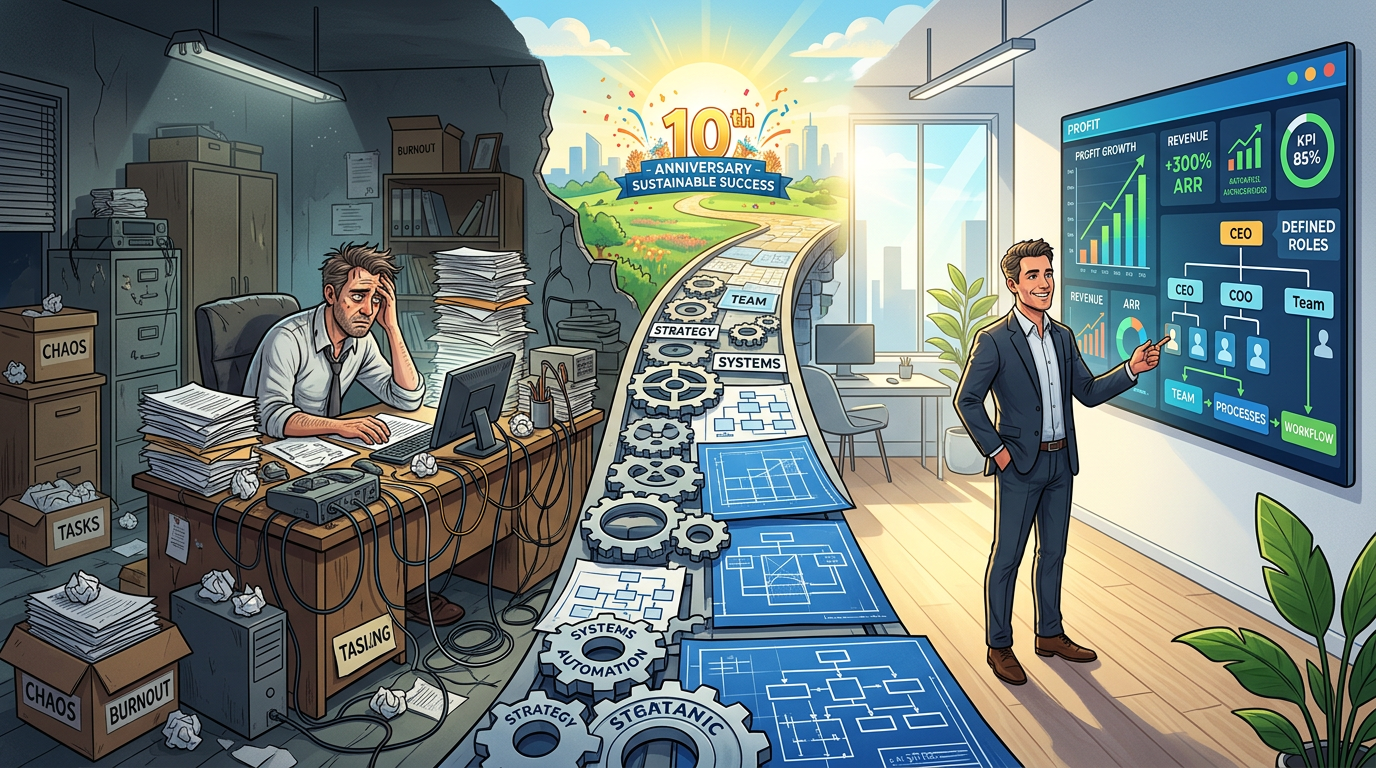
72% of businesses fail before their tenth anniversary. And the reason isn't complicated. It's that most business owners are building a job, not a business. They're solving the wrong problems because they don't understand what the real problems are. 

The first reason most businesses fail is simple. You've created a job, not a business. Your business only works when you're working. The moment you get sick, or take a holiday or worse burn out, the whole thing stops. No revenue. No forward movement. Nothing.
If you disappeared tomorrow, what would actually happen to your business? Not in a week or a month, but tomorrow. If the answer is that it would collapse, then you don't have a business. You have a job with hundreds maybe thousands of unforgiving employers (your customers).
According to the Harvard Business Review, 73% of small business owners report working more than fifty hours per week. And many are working sixty, seventy, even eighty hours. But the harder you work, the less time you have to actually build the systems that let your business run without you. You're so busy doing the work that you never have time to systematise it. You're trapped. 
And the fix isn't what you think either. It's not working harder. It's documenting what you do to create standard operating procedures. Then train your team. It may not be perfect but it’s the difference between a job and a business. A business which can run without you.
How many core tasks could your business do without you? If the answer is not many, then you've found your first problem. That's where you start. 

The second reason businesses fail is: you don't actually know if you're making money. You think you are. Your bank account looks okay. You're paying your bills. But you have no idea what your real profit is. You have no idea where your money is going. You have no idea whether you're actually moving forward or slowly falling behind. You're flying blind.
A study by Clutch found that 60% of small business owners don't track their finances regularly. They hope but hope is not a financial strategy.
You think you're winning when you're actually losing. You make decisions based on feeling instead of facts. You hire people you don't need. You take on work that doesn't make sense. And before you know it, you're exhausted and broke.
You need just three numbers. Your revenue, your profit, and your cash position. Not once a year when your accountant finally gets to it. You need to know where you stand every single month. That clarity changes everything. It changes how you make decisions. It changes what you prioritise.

The third mistake is about fragility in that you're relying on just one thing. One customer. One product. One market. One person. And the moment that one thing changes, everything falls apart. You're fragile. 
The U.S. Small Business Administration found that businesses with diversified revenue streams are two and a half times more likely to survive economic downturns than those dependent on a single revenue source.
You need multiple revenue streams. You need multiple customers. You need multiple ways your business creates value. If you lose one customer and it threatens the entire business, you're one customer away from failure. That's not a business. That's a house of cards.
But even if you fix all three of those problems, there's one more thing that most owners are missing. And this one is subtle. It's the reason why even successful-looking businesses eventually fail.

Most business owners are so busy dealing with today that they never think about tomorrow. You react to problems instead of preventing them. A customer calls with an urgent need, you drop everything. A competitor launches something new; you panic and pivot. A new opportunity shows up, you chase it. You're constantly reacting. And you have no idea where you're actually heading. You have no strategic direction.
According to research from Bain & Company, businesses with clear strategic direction grow 23% faster and maintain 30% higher profit margins than those without one. Those are not small differences. 
So how do you create a simple strategy. We ask three questions: Who are your ideal customers? What are you the best at? Where do you want to be in three years? Once we answered those questions, everything changes. Suddenly, decisions are easy. Should we take on that client? No, they don't fit our strategy. Should we offer that service? No, it doesn't align with where we're going. Should we chase that opportunity? No, it's a distraction. Every decision became clearer. 

So, you've spotted the mistakes. You understand what's broken. But what do you actually do about it? 
Step one: Document your core processes. Spend the next two weeks writing down exactly what you do. Not perfectly. Just clearly. How do you win customers? What's your sales process? How do you deliver your service? Once it's written down, you can teach it to someone else. Once you can teach it, your business can run without you. 
Step two: Get real about your numbers. Meet with your accountant. Pull your last twelve months of financials. Know your revenue. Know your profit. Know where your money goes. Then commit to reviewing these numbers every single month. Not once a year. 
Step three: Build a plan. Not a 100-page business plan. A simple strategy. Answer the three questions above and write them down. Share it with your team. Use it to make decisions. Everything else flows from this.

The businesses that last aren't the smartest. They're not the luckiest. They're the ones who face reality, who see the problems clearly, who fix the obvious mistakes, and who stick with it. The mistakes we talked about today are not unusual. They're predictable. They're preventable. And you can fix them starting today. 

I am on a mission to change the statistic that says 72% of businesses fail to reach their 10th birthday to 72% of businesses live to celebrate their 10th birthday.

You’re working harder than anyone around you. Your product is solid. Your customers like you. So why does it still feel like your business is quietly falling apart? That nagging sense that something’s not quite right. 

The answer isn’t effort. It’s not that you’re not smart enough or that you don’t care enough. The answer is that you’re solving the wrong problems. 

Today, I want to walk you through the real reasons businesses collapse, and I promise you, they’re nothing like what you’ve probably heard before. These aren’t about market conditions or bad luck. These are about the predictable, preventable mistakes that every struggling owner is making right now. And the good news? Once you see them, you can fix them.

72% of businesses fail before their tenth anniversary. And the reason isn’t complicated. It’s that most business owners are building a job, not a business. They’re solving the wrong problems because they don’t understand what the real problems are. 

The first reason most businesses fail is simple. You’ve created a job, not a business. Your business only works when you’re working. The moment you get sick, or take a holiday or worse burn out, the whole thing stops. No revenue. No forward movement. Nothing.

If you disappeared tomorrow, what would actually happen to your business? Not in a week or a month, but tomorrow. If the answer is that it would collapse, then you don’t have a business. You have a job with hundreds maybe thousands of unforgiving employers (your customers).

According to the Harvard Business Review, 73% of small business owners report working more than fifty hours per week. And many are working sixty, seventy, even eighty hours. But the harder you work, the less time you have to actually build the systems that let your business run without you. You’re so busy doing the work that you never have time to systematise it. You’re trapped. 

And the fix isn’t what you think either. It’s not working harder. It’s documenting what you do to create standard operating procedures. Then train your team. It may not be perfect but it’s the difference between a job and a business. A business which can run without you.

How many core tasks could your business do without you? If the answer is not many, then you’ve found your first problem. That’s where you start. 

The second reason businesses fail is: you don’t actually know if you’re making money. You think you are. Your bank account looks okay. You’re paying your bills. But you have no idea what your real profit is. You have no idea where your money is going. You have no idea whether you’re actually moving forward or slowly falling behind. You’re flying blind.

A study by Clutch found that 60% of small business owners don’t track their finances regularly. They hope but hope is not a financial strategy.

You think you’re winning when you’re actually losing. You make decisions based on feeling instead of facts. You hire people you don’t need. You take on work that doesn’t make sense. And before you know it, you’re exhausted and broke.

You need just three numbers. Your revenue, your profit, and your cash position. Not once a year when your accountant finally gets to it. You need to know where you stand every single month. That clarity changes everything. It changes how you make decisions. It changes what you prioritise.

The third mistake is about fragility in that you’re relying on just one thing. One customer. One product. One market. One person. And the moment that one thing changes, everything falls apart. You’re fragile. 

The U.S. Small Business Administration found that businesses with diversified revenue streams are two and a half times more likely to survive economic downturns than those dependent on a single revenue source.

You need multiple revenue streams. You need multiple customers. You need multiple ways your business creates value. If you lose one customer and it threatens the entire business, you’re one customer away from failure. That’s not a business. That’s a house of cards.

But even if you fix all three of those problems, there’s one more thing that most owners are missing. And this one is subtle. It’s the reason why even successful-looking businesses eventually fail.

Most business owners are so busy dealing with today that they never think about tomorrow. You react to problems instead of preventing them. A customer calls with an urgent need, you drop everything. A competitor launches something new; you panic and pivot. A new opportunity shows up, you chase it. You’re constantly reacting. And you have no idea where you’re actually heading. You have no strategic direction.

According to research from Bain & Company, businesses with clear strategic direction grow 23% faster and maintain 30% higher profit margins than those without one. Those are not small differences. 

So how do you create a simple strategy. We ask three questions: Who are your ideal customers? What are you the best at? Where do you want to be in three years? Once we answered those questions, everything changes. Suddenly, decisions are easy. Should we take on that client? No, they don’t fit our strategy. Should we offer that service? No, it doesn’t align with where we’re going. Should we chase that opportunity? No, it’s a distraction. Every decision became clearer. 

So, you’ve spotted the mistakes. You understand what’s broken. But what do you actually do about it? 

Step one: Document your core processes. Spend the next two weeks writing down exactly what you do. Not perfectly. Just clearly. How do you win customers? What’s your sales process? How do you deliver your service? Once it’s written down, you can teach it to someone else. Once you can teach it, your business can run without you. 

Step two: Get real about your numbers. Meet with your accountant. Pull your last twelve months of financials. Know your revenue. Know your profit. Know where your money goes. Then commit to reviewing these numbers every single month. Not once a year. 

Step three: Build a plan. Not a 100-page business plan. A simple strategy. Answer the three questions above and write them down. Share it with your team. Use it to make decisions. Everything else flows from this.

The businesses that last aren’t the smartest. They’re not the luckiest. They’re the ones who face reality, who see the problems clearly, who fix the obvious mistakes, and who stick with it. The mistakes we talked about today are not unusual. They’re predictable. They’re preventable. And you can fix them starting today. 

I am on a mission to change the statistic that says 72% of businesses fail to reach their 10th birthday to 72% of businesses live to celebrate their 10th birthday.